The Kiswa of the Kaaba: what's written on it and how it's made
Phrases like "Subhan Allah wa bihamdihi" are woven into the black silk of the kiswah. How it is made, what is written on it, and when it is changed.
9 min read
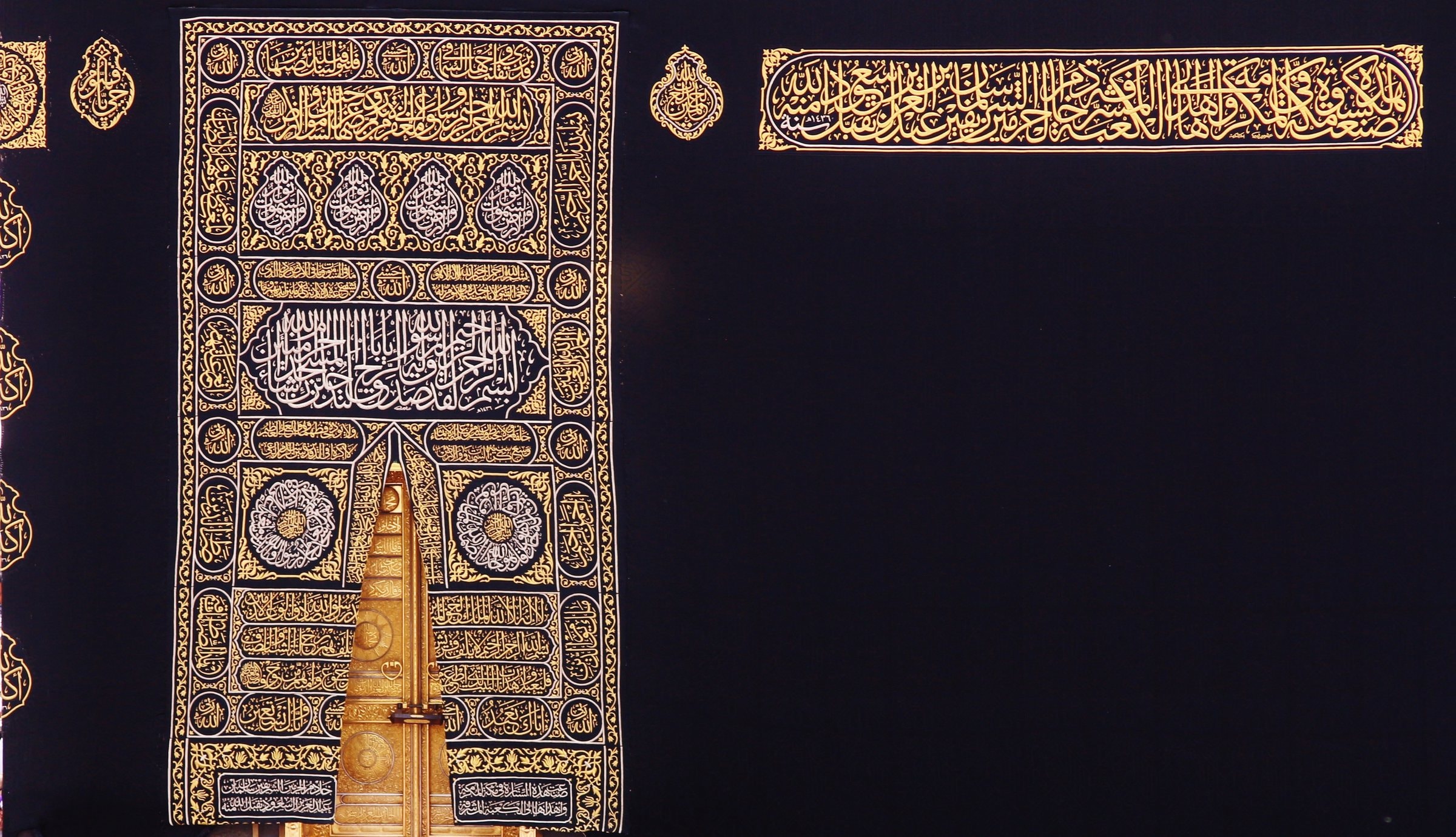
Phrases are woven into the black silk of the Kaaba's Kiswa itself: "Ya Allah", "Subhan Allah wa bihamdihi, Subhan Allah al-Azim", "Ya Dayyan", "Ya Mannan" and "La ilaha illa Allah, Muhammad Rasul Allah". Jacquard looms at the King Abdulaziz Complex for the Holy Kaaba Kiswa in Makkah weave them in, the Saudi Press Agency (SPA) reported in 2022, and you see them when you stand close to the cloth.
The Kiswa on the Kaaba today is the one for 1448 AH. SPA says it took 150 Saudi craftsmen 11 months to make: 47 pieces of black silk, embroidered with 30 verses of the Quran in silver thread plated with 24-carat gold, weighing 1,410 kg in all.
Our guide to ziyarat in Makkah has a few lines on the complex where it is made. This one is about the Kiswa itself: what is written on it, how it is changed every year, and where to look when you stand in front of the Kaaba.
What it is made of
One Kiswa takes about 825 kg of raw silk, 120 kg of gold-plated silver wire, 60 kg of pure silver and 410 kg of raw cotton, according to the complex (SPA, 2026). The silk is pure natural silk from Italy, and the gold-plated silver thread comes from Germany (SPA, 2025).
Making it takes seven stages. First the water used to wash the silk is desalinated. The silk is washed and dyed, black for the outer Kiswa and green for the inner one and for the cover of the Prophet's Chamber in Madinah. It is woven by machine, with more than 9,900 threads to the metre, and the verses and patterns are printed on it. The pieces are then joined and sewn, and the gold work is embroidered in silver and gold-plated silver over cotton padding that makes the letters stand out. Quality control comes last.
The cloth is 14 m high. Around its upper third runs a belt 95 cm wide and 47 m long, made of 16 pieces (SPA, 2026). The state pays for it: 25 million riyals a year, SPA said in 2025. The figures shift a little from one year's Kiswa to the next, and these are the latest SPA has published.
What is written on it
- The silk itself: the woven phrases at the top of this post.
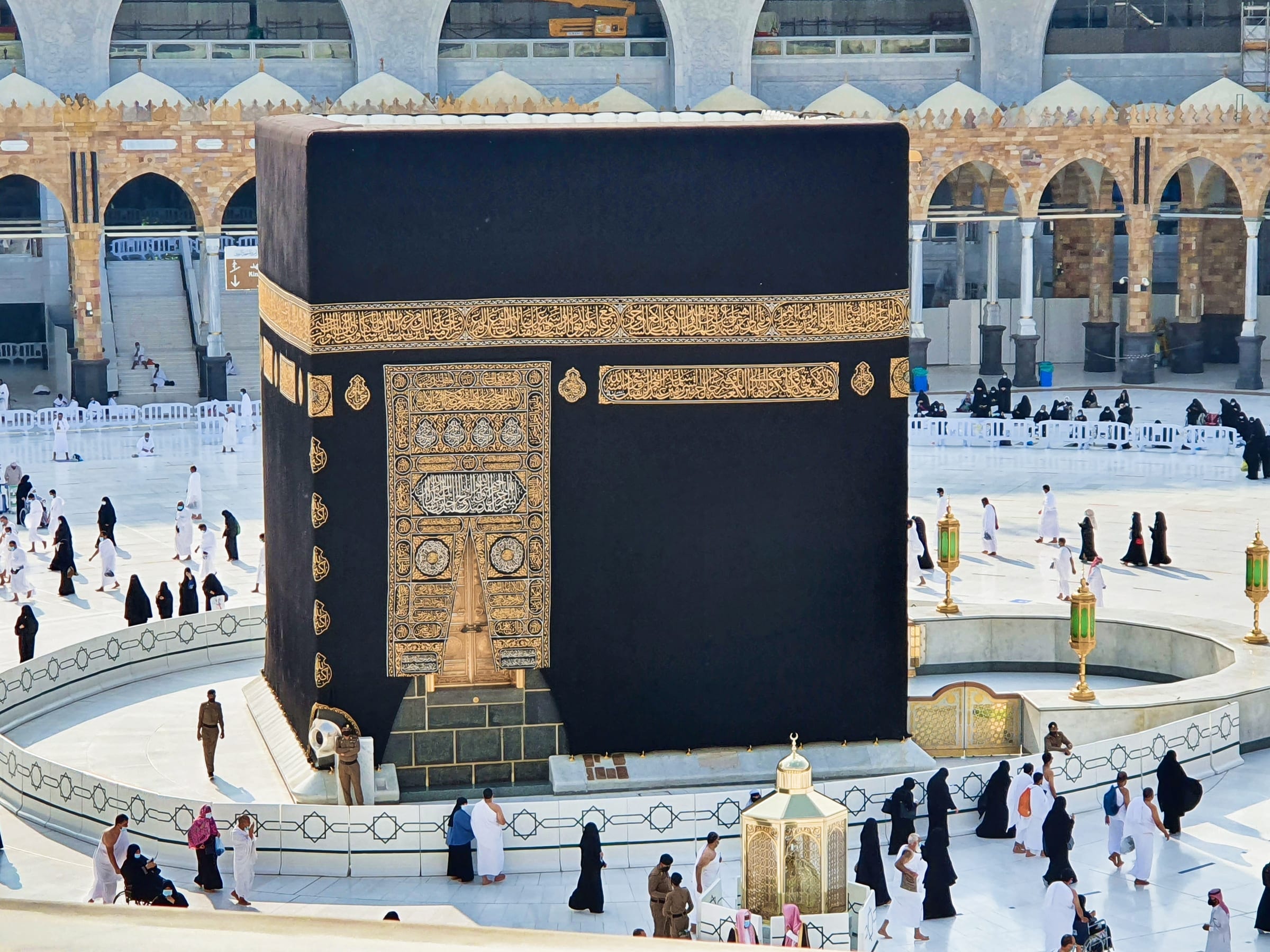
- The belt: verses of the Quran in thuluth jali. Abdulrahman al-Maliki, a calligrapher at the complex, told SPA in 2025 that the script was chosen because it fits the most words into a narrow band.
- The lamps (qanadil) under the belt: one of them reads "Allāh is the Light of the heavens and the earth" (an-Nur 35, Sahih International).
- The samadiyat, the pieces at the four corners: Surat al-Ikhlas, Say, "He is Allāh, [who is] One, Allāh, the Eternal Refuge." (al-Ikhlas 1 and 2, Sahih International)
- The door curtain, 6.35 m long and 3.33 m wide: chosen words are embroidered on it, among them "Allah", "Subhan Allah wa bihamdihi" and "Ya Hayy ya Qayyum" (SPA, 2025).
- The dedication piece: it says the Kiswa was made in Makkah, who gave it to the Kaaba, and the year.
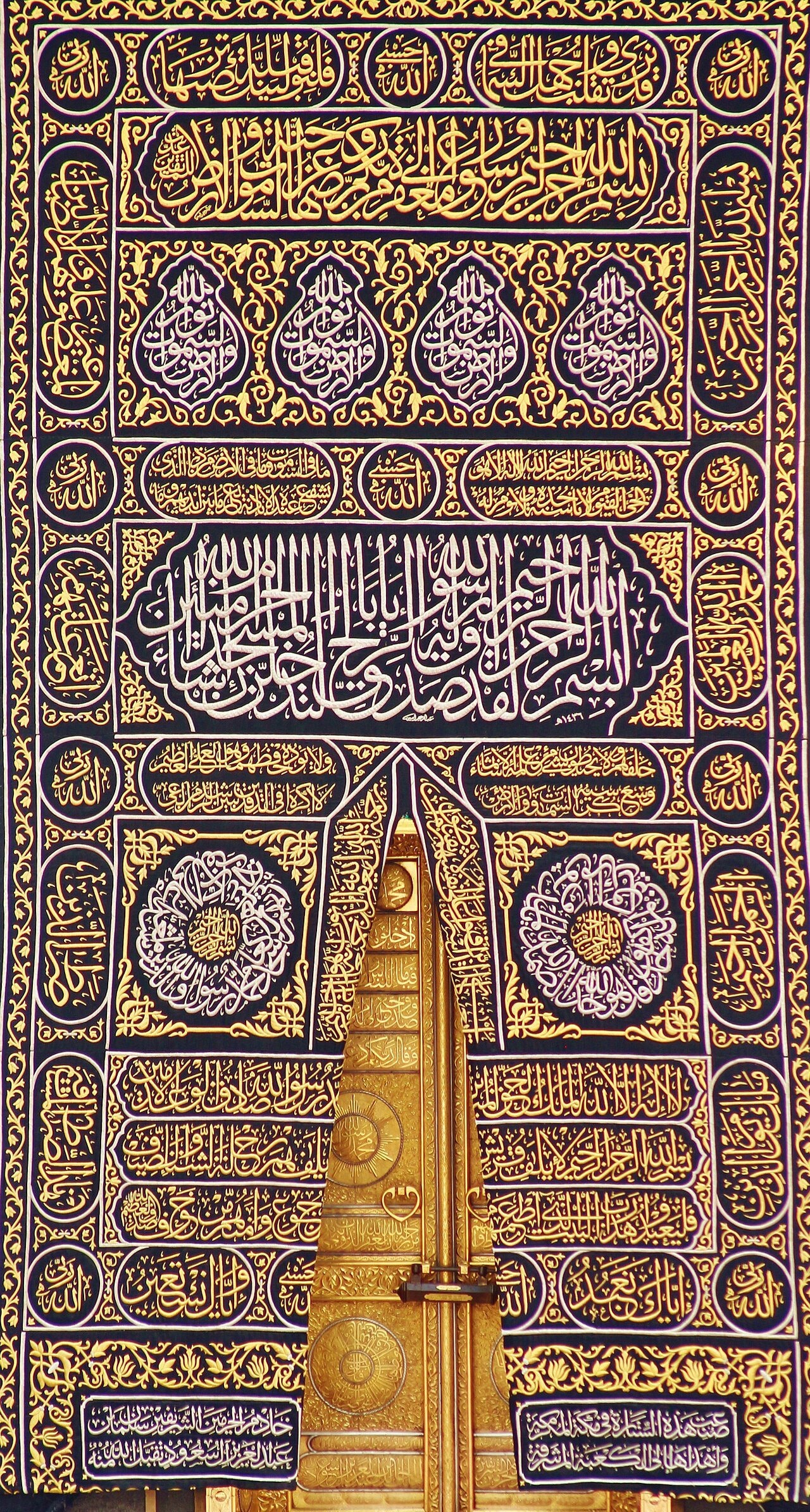
Inside, the walls of the Kaaba are hung with green silk made at the same complex. It carries verse 96 of Al Imran, about the first House set up for people, at Bakkah, and "Ya Hannan, ya Mannan, ya Dhal-Jalali wal-Ikram" (SPA, 2024).
"A day on which the Kaaba will be clothed"
On the day of the Conquest of Makkah, Sa'd ibn Ubadah told Abu Sufyan that it was a day of slaughter, the day the Kaaba's sanctity would be broken. When Abu Sufyan told the Prophet ﷺ, he said Sa'd was wrong, and then:
"Today Allah will give superiority to the Ka'ba and today the Ka'ba will be covered with a (cloth) covering." (al-Bukhari 4280, from Urwa ibn al-Zubayr)
Aisha said that people used to fast the day of Ashura before fasting in Ramadan was made obligatory, and that it was the day the Kaaba was covered (al-Bukhari 1592).
How it is changed every year
Until 1443 AH (2022) the Kiswa was changed on the morning of the Day of Arafah, 9 Dhu al-Hijjah, while the pilgrims were at Arafat. That year a royal directive moved it: the Kiswa is now handed to the chief custodian of the Kaaba on 10 Dhu al-Hijjah and changed on 1 Muharram, the first day of the Hijri year. The first change on the new date was on 1 Muharram 1444 AH (30 July 2022).
So after Hajj the new Kiswa goes to the custodians of the Kaaba. On 12 Dhu al-Hijjah 1447 AH (29 May 2026), Prince Saud bin Mishal, deputy emir of the Makkah region, handed it over on the King's behalf, and the chief custodian, Abdulmalik bin Taha Al-Shaibi, signed the record.
Then comes the night of the change, as SPA described it in 1447 AH:
- After Asr on the last day of Dhu al-Hijjah, the door curtain comes down, and the corner pieces, lamps and ornaments are taken off.
- After Isha the new Kiswa is brought from the complex to Masjid al-Haram.
- Each new side is raised to the roof and spread over the old one, and the old one is let down from underneath. This happens four times, once for each side.
- The belt is lined up straight on all four sides and sewn, the corners are sewn from top to bottom, and the door curtain goes on.
In 1447 AH the change took 154 craftsmen and 8 cranes, and was finished after midnight. It is broadcast live.
The next change is on the night of 1 Muharram 1449 AH, which the Umm al-Qura calendar puts on Sunday 6 June 2027, so the work runs through the night of 5 to 6 June.
The old Kiswa goes back to the complex and is kept in its store, the complex's director general told SPA in 1438 AH (2017). The complex has a section that conserves the Kiswas of past years, and some are later shown in museums, according to Discover Makkah, the visitor site of the Royal Commission for Makkah City and Holy Sites.
Why it is raised for Hajj
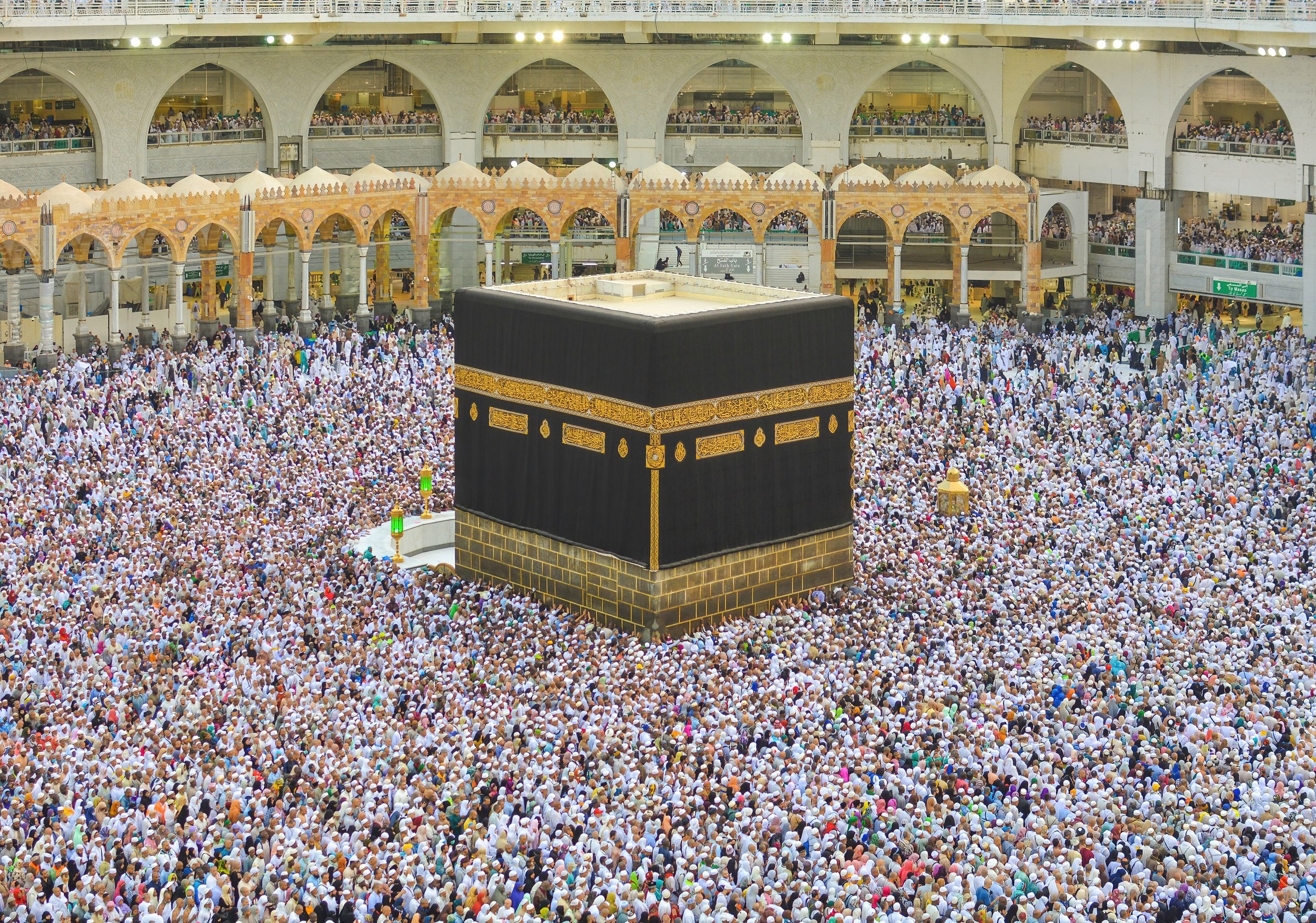
Every year before Hajj the lower part of the Kiswa is raised by 3 m, and the raised part is covered with white cotton 2 m wide on all four sides. In 1447 AH this was done on 1 Dhu al-Qa'dah (18 April 2026) by 34 craftsmen, in about two hours. The aim, the General Authority for the Care of the Two Holy Mosques says, is to protect the Kiswa from touching and damage in the crowded tawaf. SPA gives another reason: to stop people cutting off pieces to keep or for blessing.
The custom is called tashmir al-Kaaba, rolling up the Kaaba's cloth, and people call it "the ihram of the Kaaba". SPA notes that it is not an act of worship. The traveller Ibn Jubayr wrote that on 27 Dhu al-Qa'dah the curtains were rolled up about a man's height and a half on all four sides, and that people called this the Kaaba's ihram.
Who has clothed the Kaaba
- Adnan, an ancestor of the Prophet ﷺ, is named among those who clothed it. It is said that Tubba' al-Himyari, a king of Yemen, was the first to clothe it before Islam, after visiting Makkah, and the first to give it a door and a key.
- Qusayy ibn Kilab organised the clothing of the Kaaba among the clans of Quraysh. Later Abu Rabi'a Abdullah ibn Amr al-Makhzumi, a rich merchant, offered to clothe it one year if Quraysh clothed it the next, and they agreed.
- Abu Bakr and Umar clothed it in qabati, fine Egyptian linen, and Yemeni cloth. Uthman was the first in Islam to put two Kiswas on it, one over the other.
- Under the Umayyads it was clothed twice a year: on Ashura, and at the end of Ramadan, ready for Eid al-Fitr.
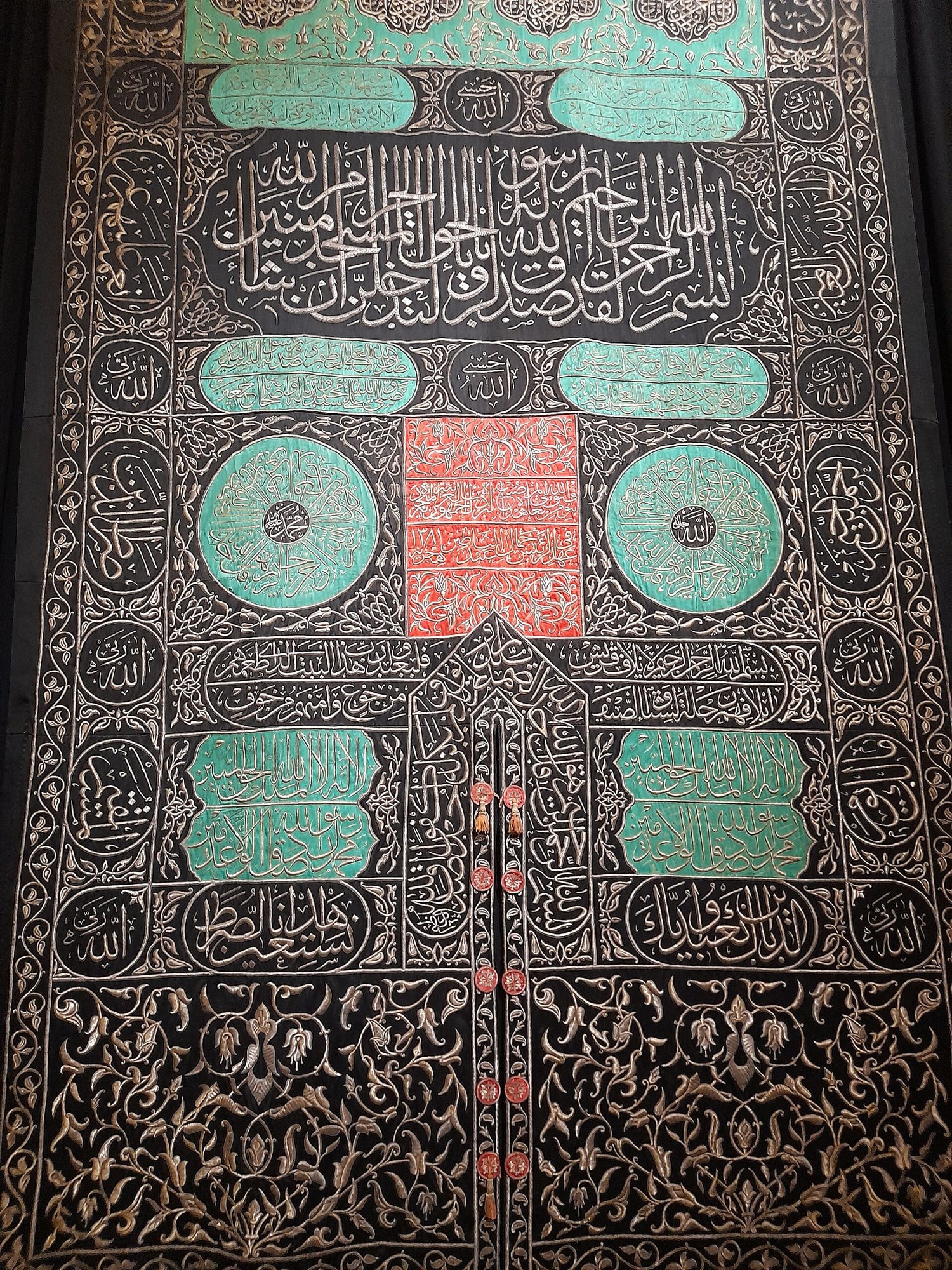
- Under the Abbasids it was made in the Egyptian towns of Tinnis, Tuna and Shata, and the caliph al-Ma'mun clothed it three times a year. Writing on the Kiswa began then: the caliphs put their names on it, with where it was made and when.
- For centuries the Kiswa was sent from Egypt, apart from short breaks, until that stopped for good in 1381 AH (1962).
- In Muharram 1346 AH (1927) King Abdulaziz ordered a house in Ajyad for making the Kiswa, the first in the Hijaz set aside for weaving it. On 1 Rajab that year twelve hand looms arrived from India with 60 workers, 40 of them master embroiderers, and the Kiswa was finished at the end of Dhu al-Qa'dah 1346 (1928).
- Under King Saud a factory opened in Jarwal. The first Kiswa made there carried the words: "This Kiswa was made in Makkah al-Mukarramah and given to the Holy Kaaba by King Saud bin Abdulaziz Al Saud, may Allah accept it from him."
- In 1397 AH (1977) the factory moved to its building in Umm al-Joud, and in 1439 AH (2018) it was renamed the King Abdulaziz Complex for the Holy Kaaba Kiswa.
Standing at the Kaaba
- The belt runs around the upper third of the cloth with the lamps hanging under it, and the samadiyat sit at the four corners. The door curtain is on the wall with the door, next to the Black Stone corner.
- The Authority says the crowd in Masjid al-Haram is usually lightest from 10 pm to 4 am and from 9 am to 4 pm (August 2026). There is more in our post on the Black Stone.
- Sheikh Ibn Baz was asked about wiping the walls of the Kaaba and its Kiswa. It has no basis, he said, since the Prophet ﷺ did not do it: what is prescribed is kissing and touching the Black Stone, and touching the Yemeni corner with your hand. Standing at the Multazam, between the corner and the door, with your chest and hands on it in du'a, is worship, he said, and there is nothing wrong with it.
- The Multazam is perfumed with oud every day. If you are in ihram, read what scholars say about that perfume in the same post.
Visiting the Kiswa complex
The complex is in Umm al-Joud, on the old Makkah to Jeddah road, about 10 km from the Haram. Inside you can follow the stages of making the Kiswa, see the weaving tools and the inscriptions, and watch the craftsmen at work.
The visits portal of the General Authority for the Care of the Two Holy Mosques (visits.alharamain.gov.sa) gives the hours as Sunday to Thursday, 8 to 11 a.m., with free entry. Other official pages have given other days, so check the portal before you go. More places to visit are in ziyarat in Makkah.
If your Umrah falls in Dhu al-Qa'dah or Dhu al-Hijjah, you'll see the Kiswa raised 3 m off the base of the Kaaba, with white cotton below it. It is lifted every year before Hajj to protect it in the crowds.
Hotels near Masjid al-Haram
Compare the walk, the view and the price, then book in minutes.
See the hotelsSources
- SPA: the Kaaba puts on its Kiswa for 1448 AH, made by 150 Saudi craftsmen, 1 Muharram 1448 (16 June 2026) · Checked 19 Nov 2026
- SPA: the seven stages of making the Kiswa, and its materials, 12 June 2026 · Checked 19 Nov 2026
- SPA: the seven fabrics of the Kiswa, 15 June 2026 · Checked 19 Nov 2026
- SPA: the night of the change of the Kiswa, 14 June 2026 · Checked 19 Nov 2026
- SPA: the deputy emir of the Makkah region hands the Kiswa to the custodians of the Kaaba, 29 May 2026 · Checked 19 Nov 2026
- SPA: the lower part of the Kiswa raised 3 m for Hajj 1447 AH, 18 April 2026 · Checked 19 Nov 2026
- SPA: raising the Kiswa, a yearly custom before Hajj (with Ibn Jubayr's account), 1 June 2025 · Checked 19 Nov 2026
- SPA: thuluth jali on the Kiswa, the door curtain, the lamps, the samadiyat and the yearly cost, 3 June 2025 · Checked 19 Nov 2026
- SPA: the door curtain taken down before the change, 25 June 2025 · Checked 19 Nov 2026
- SPA: the Authority finishes the change of the Kiswa, 1 Muharram 1447 (26 June 2025) · Checked 19 Nov 2026
- SPA: thuluth on the Kiswa, and the stages of the change, 26 June 2025 · Checked 19 Nov 2026
- SPA: the change of 1 Muharram 1446, and the green inner Kiswa, 7 July 2024 · Checked 19 Nov 2026
- SPA: silk, gold and silver, the Kiswa woven every year (jacquard phrases, Ajyad, Jarwal, Umm al-Joud), 27 July 2022 · Checked 19 Nov 2026
- SPA: royal directive to change the Kiswa on 1 Muharram, 4 July 2022 · Checked 19 Nov 2026
- SPA: the Kiswa, a cover of silk (its history), 22 July 2020 · Checked 19 Nov 2026
- SPA: the Kiswa changed on the morning of 9 Dhu al-Hijjah, 19 August 2018 · Checked 19 Nov 2026
- SPA: the old Kiswa goes back to the factory's store, 30 August 2017 · Checked 19 Nov 2026
- SPA: the dedication piece and the parts of the Kiswa, 4 September 2016 · Checked 19 Nov 2026
- SPA: the Kiswa sent from Egypt until 1381 AH, and the house in Ajyad in 1346 AH · Checked 19 Nov 2026
- General Authority for the Care of the Two Holy Mosques, visits portal: King Abdulaziz Complex for the Kaaba Kiswah (hours and entry) · Checked 19 Nov 2026
- Discover Makkah (Royal Commission for Makkah City and Holy Sites): King Abdulaziz Complex for the Kaaba Kiswa · Checked 19 Nov 2026
- Dorar: Sahih al-Bukhari 4280, a day on which the Kaaba will be clothed (sahih) · Checked 19 Nov 2026
- Sunnah.com: Sahih al-Bukhari 4280 · Checked 19 Nov 2026
- Dorar: Sahih al-Bukhari 1592, Ashura was the day the Kaaba was covered (sahih) · Checked 19 Nov 2026
- Sunnah.com: Sahih al-Bukhari 1592 · Checked 19 Nov 2026
- Ibn Baz, fatwa 11794: wiping the Kaaba and its Kiswa · Checked 19 Nov 2026
- Tanzil: the Quran text (an-Nur 35, al-Ikhlas 1 to 2, Al Imran 96) · Checked 19 Nov 2026
- Quran.com: translations of an-Nur 35 and al-Ikhlas 1 to 2 (Sahih International, Kemenag, Basmeih, Diyanet, Hamidullah) · Checked 19 Nov 2026